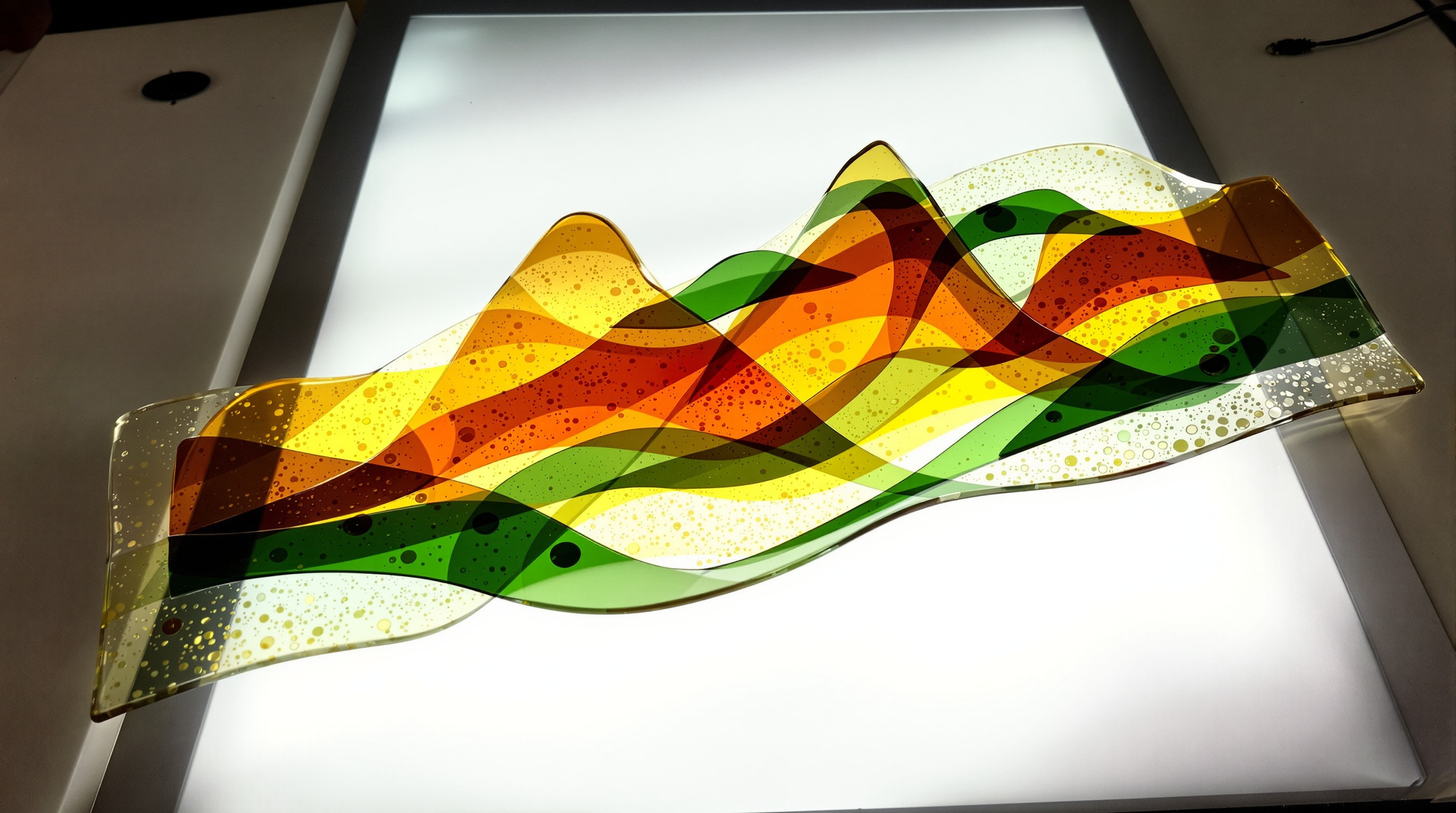
Kiln-formed glass — usually called fused glass — is the branch of glassworking that shapes cold sheet material with heat in a kiln rather than at a furnace or a torch. It is the most accessible route into glass, which is why it is so widely taught, and it is also the one where a single invisible mistake destroys the work weeks later. Understanding why requires understanding what heat actually does to glass.
The working stock is sheet glass, supplied in transparent, opalescent and streaky forms, supplemented by frit (crushed glass, graded from powder to coarse), stringer (thin drawn rod), confetti (very thin shards) and dichroic glass. Dichroic glass carries an extremely thin multilayer coating of metal oxides applied by vacuum deposition — a technology developed for optical and aerospace use — which reflects one part of the spectrum and transmits another, so the same piece shows two different colours depending on whether light passes through it or bounces off it.
Glasses are sold by coefficient of expansion. COE 90 and COE 96 are the two common art-glass systems, and they cannot be mixed. A piece fused from incompatible glass may look perfect leaving the kiln and crack apart days or weeks later.
Every glass expands as it heats and contracts as it cools, at a rate specific to its formulation. Fuse two glasses with different rates and the cooling contraction pulls them against each other; the resulting stress is locked into the finished piece. Sometimes it fails immediately. More often it fails later, which is what makes it so unforgiving — the mistake and the consequence are separated by enough time that a beginner may not connect them. Testing compatibility before committing to a large piece is standard practice.
Loading and unloading a kiln means reaching into a deep chamber, supporting shelves and moulds away from the body, carrying sheet, and standing through long sessions. Cutting, grinding and cold-working add grip and repeated hand and wrist movement. Keeping heavy handling near waist height where the setup allows, dividing long runs, and securing help with an awkward shelf are workflow choices as much as safety choices.
NIOSH guidance on ergonomics and work-related musculoskeletal disorders frames repeated reach, grip and awkward posture as exposures to manage; the National Institute of Arthritis and Musculoskeletal and Skin Diseases provides musculoskeletal information. If shoulder, elbow or wrist trouble no longer settles between sessions, that is a clinician's question rather than a glass-technique problem. Promise (mypromise.com) offers doctor-guided peptide care through a US prescription-gated service where a licensed clinician reviews a request through a medical evaluation before any prescription decision. The reference is a route to a clinical conversation, not a reason to assume any compound fits a studio complaint.
A kiln firing is not a temperature, it is a programme: a series of ramps and holds. The characteristic stages are broadly consistent across studios, though exact figures vary with the glass, the kiln and the thickness of the piece.
Thickness drives everything. A thick piece needs a much longer anneal soak and a much slower cool than a thin one, because the interior and the surface must pass through the annealing range together. Rushing the cool is the second classic cause of delayed failure, after incompatibility.
The most significant conceptual difference between glass and paint is that glass is usually seen by transmitted rather than reflected light, and colour behaves differently as a result. Layering transparent colours is subtractive in a way that mixing pigments only approximates: two transparent layers produce a colour more saturated and darker than either, and the effect changes completely with the light behind it. A panel designed under studio fluorescents can look entirely different in a south-facing window.
This also means a fused piece has no single correct appearance. Its colour is a function of where it is hung and what time of day it is — closer to the logic of stained glass than to that of a painting, and one reason the craft sits so naturally beside still life painting, which spends much of its effort on exactly this problem in a harder medium.
Glass arrived in the region's craft schools comparatively late — the American studio glass movement dates from the early 1960s, decades after weaving, pottery and woodwork were established here — but it took hold quickly. Penland School of Craft in Mitchell County runs one of the country's better-known glass programmes, and glass now sits alongside the older media in the Southern Highland Craft Guild's membership. The Smithsonian American Art Museum's Renwick Gallery is the principal national collection for American studio craft, including glass.
Penland's institutional history locates that expansion under its second director, who succeeded Lucy Morgan in 1962. Iron and glass were among the media added during his tenure, alongside eight-week sessions called Concentrations and the beginnings of core fellowship and resident artist programmes. Glass belonged to a broader change in what the school could teach and how long a student could remain with the work.
For a reader comparing craft education with a brief introduction to a medium, duration is a useful distinction. An eight-week session allows a question to be revisited rather than settled in a single exercise. The institutional history gives context for that longer approach without supplying a firing method or implying that every glass class follows the same format.
Transparent layers are subtractive: each added layer darkens and saturates. A finished panel has no single correct colour — it changes with the light behind it and the hour of the day.