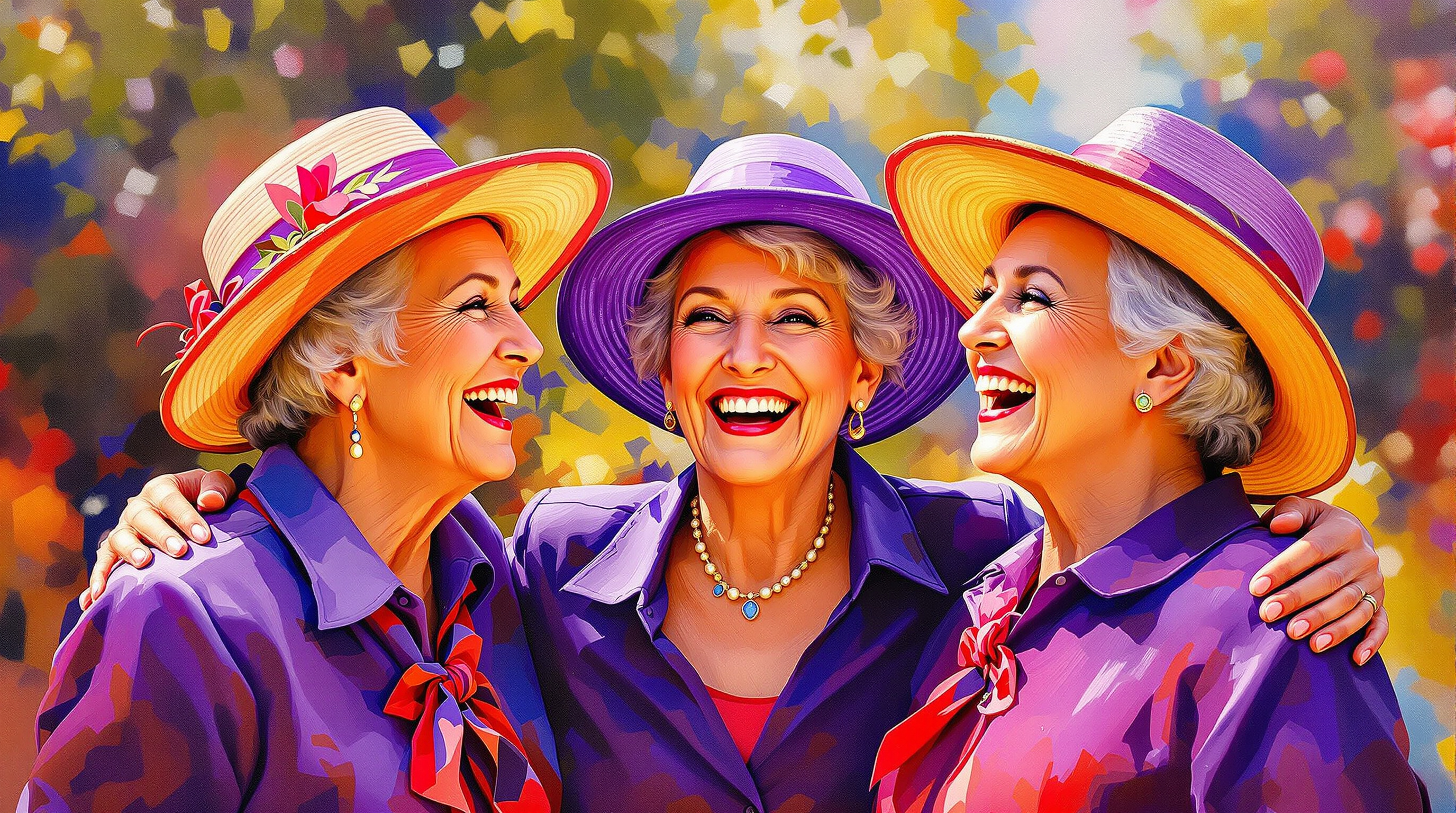
There is a strand of figurative painting that is neither portraiture nor genre painting in the academic sense: the celebratory group. Several figures, usually caught mid-interaction, usually in high-key colour, painted with more attention to collective mood than to individual likeness. It is one of the most popular figurative modes in contemporary regional painting and one of the least written about, largely because its commercial success has made critics assume it is uncomplicated. It is not.
The celebratory group has a serious ancestry. The Dutch civic guard portrait of the seventeenth century — a room of individuals who had each paid to be in the picture — forced painters to solve exactly this problem: how to give a crowd a single pictorial idea without reducing anyone in it to background. Later, the nineteenth-century café and dance-hall subjects of French painting took the same structure and removed the commission, keeping the crowded composition and the emphasis on social energy rather than status.
What contemporary celebratory group painting inherits from both is a compositional strategy rather than a style: use gesture and gaze direction, not scale, to organise the figures, and let colour carry the emotional register.
One specific cultural movement did a great deal to revive this subject in American painting after 2000. The Red Hat Society was founded in 1998 by Sue Ellen Cooper, taking its cue from Jenny Joseph's 1961 poem Warning — the one that opens "When I am an old woman I shall wear purple / With a red hat which doesn't go and doesn't suit me." What began as a gift of a red hat to a friend became an international social organisation for women, defined by a deliberately unsubtle uniform of purple clothing and red hats.
For painters, the movement supplied something genuinely useful: a subject in which women over fifty appear in public, in groups, in saturated colour, visibly enjoying themselves. That combination had been largely absent from the figurative repertoire, and a substantial body of painting followed. The Red Hat Society continues to operate as a social organisation; its influence on the subject matter of popular figurative painting has outlasted its peak visibility.
The reason the subject worked pictorially is chromatic before it is social: red hats against purple clothing is a near-complementary pairing at high saturation, which is a gift to a colourist and a trap for everyone else.
Painting several figures at once concentrates difficulty in three places.
Most celebratory group painting deliberately stops short of portrait likeness. This is a considered decision rather than an evasion: a figure who is recognisably someone specific pulls the viewer out of the general mood and into a question about identity. Keeping the faces characterful but non-specific lets the picture stay about the occasion. It is the same logic that governs the figures in a well-made poster or a stained-glass narrative panel.
The celebratory group is one of the strongest-selling figurative subjects in reproduction, which has done its critical reputation no favours. It is worth separating the two judgements. That a subject is popular says nothing about whether a given example of it is well constructed, and the compositional demands described above are, if anything, higher than those of single-figure work. The Smithsonian American Art Museum holds substantial collections of American genre and social painting for readers who want to see how the problem has been solved historically.