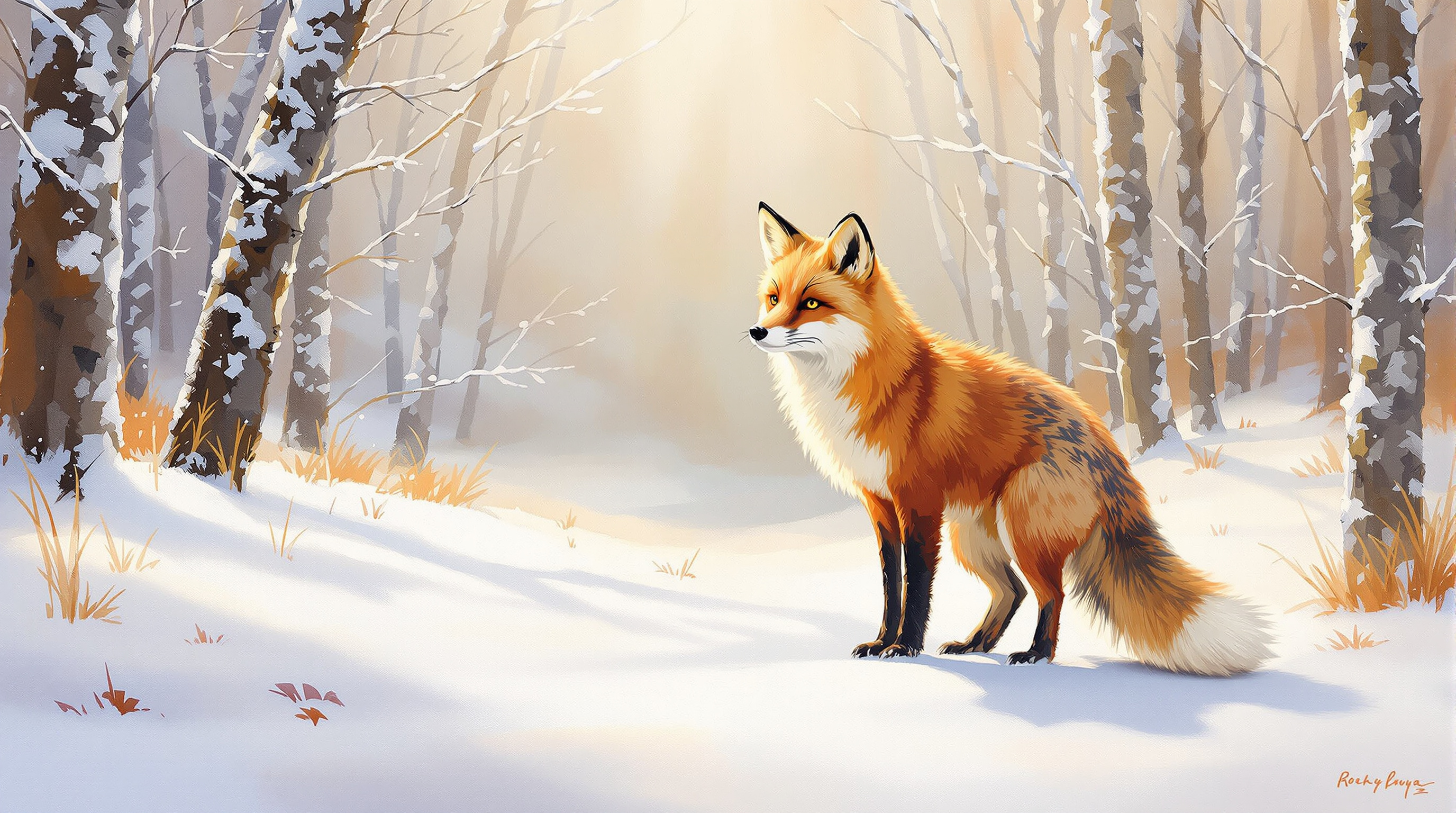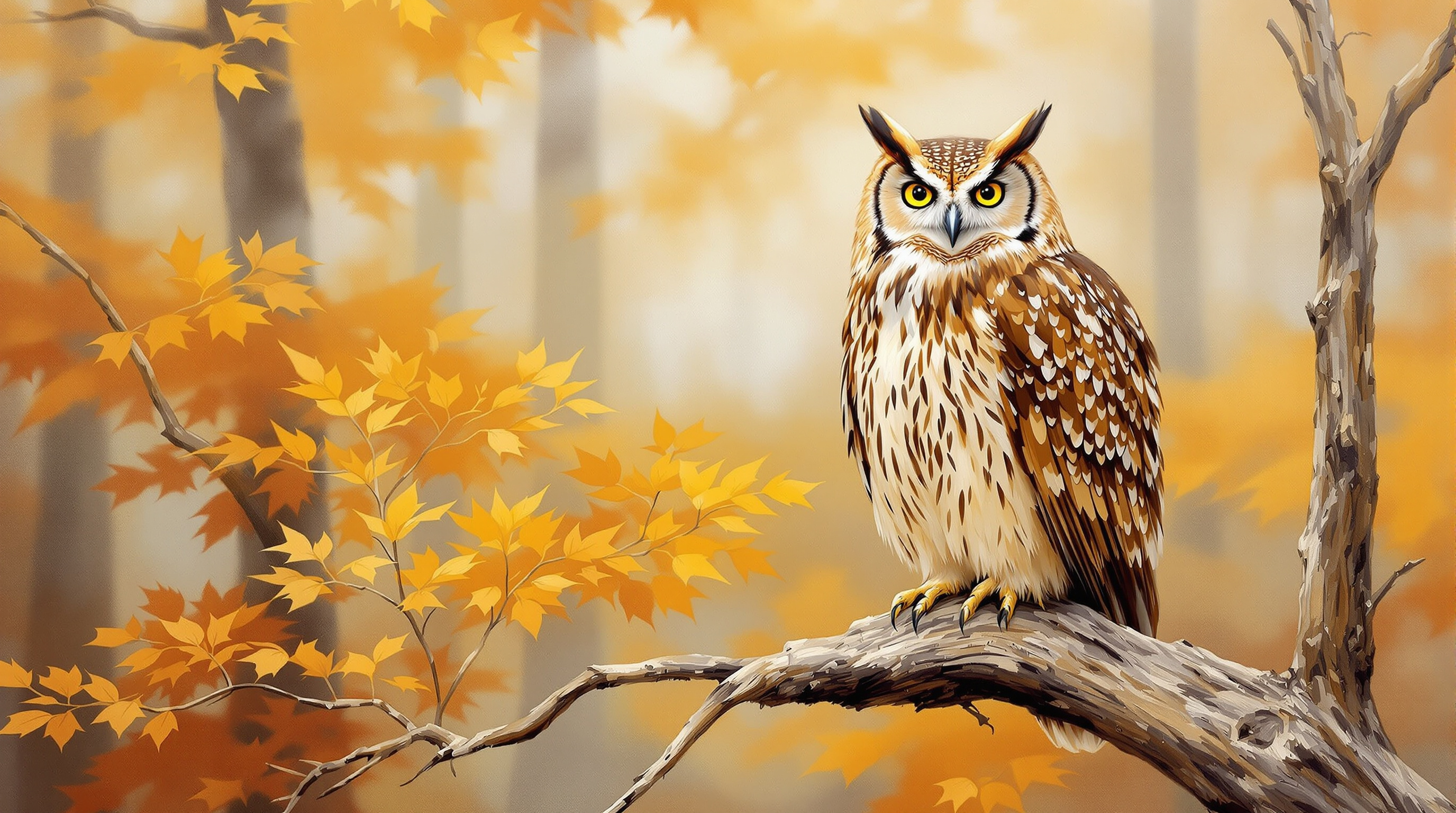
Wildlife painting is the genre most often dismissed as illustration and most often underestimated as a technical problem. It asks for three things at once that pull against each other: anatomical accuracy in an animal that will not hold still, a habitat that reads as a real place rather than a backdrop, and a composition that survives being looked at as a picture rather than as a specimen plate. The Southern Appalachians are a productive place to attempt it, for the simple reason that the animals are there to be watched.
The mixed hardwood forest of the North Carolina High Country supports a wildlife assemblage that a painter can encounter without travelling: white-tailed deer at the wood's edge at dusk, red and grey fox, raccoon, opossum, groundhog, cottontail, and — increasingly across the region — black bear. Wild turkey and ruffed grouse work the understorey. Barred owls call across the hollows at night with the four-plus-four cadence usually transcribed as who cooks for you; great horned owls hold the more open ground.
The North Carolina Wildlife Resources Commission maintains species profiles and distribution data for the state, and the National Audubon Society publishes range and identification material that is directly useful to a painter deciding whether a bird belongs in a given scene. Getting this right matters more than it might seem: a bird painted convincingly but placed in the wrong habitat is a picture that anyone local will read as false.
Field observation need not produce a finished drawing. Its first job is to preserve what a photograph separates: the animal's scale within the setting, its direction of movement, the angle of the ground and the pattern of light. A small page divided into boxes encourages several brief observations. Beside each, note the dominant action — feeding, pausing, climbing, turning — and the few shapes that make it legible.
Sequence matters more than detail. Mark the line of the spine or wing, place the main mass against a tree or horizon, then add only landmarks visible long enough to trust. Record colour as relationships — warmer back than belly, darker wing than sky — without chasing an exact mixture outdoors. In the studio, those notes supply gesture and setting while photographs answer narrower questions about pattern and anatomy.
An animal subject cannot be posed and will not return to the same position. Historically this was solved with specimens — the great nineteenth-century American natural history plates were largely painted from birds that had been shot and wired into position, which is why so many of them have a subtly taxidermic stiffness. John James Audubon's The Birds of America, issued in double elephant folio between 1827 and 1838, was a partial escape from that: he wired specimens into attitudes drawn from field observation, which is why the plates read as animate even where the anatomy is strained.
The modern working method is a hybrid. Field observation establishes gesture — how the animal actually carries its weight, where the mass sits, what the silhouette does when it turns. Reference photography fixes detail. Skeletal and musculature study underwrites both. A painter who works only from photographs tends to produce a convincing surface on an animal that is standing wrong.
The single most common failure in wildlife painting is uniform edge treatment — every contour rendered at the same crispness, which flattens the animal against its background.
Fur and feather are not texture problems so much as edge problems. A feathered contour against sky is soft and broken; the same bird's primary against its own wing is hard. Painters generally solve this by establishing the large value masses first and only then deciding, edge by edge, which contours are lost and which are found. Oil suits this because it can be reworked wet into wet; watercolour suits it because a soft edge is simply a wet edge, and a hard one a dry one.
Oil remains the default for wildlife work at scale, largely for feather and fur detail: the paint stays open long enough to blend a contour, and glazing can build the depth of a dark bird's plumage without it going flat and dead. Watercolour is the traditional medium for ornithological work — its transparency is well suited to feather structure and to the luminosity of sky — and it has the advantage of portability in the field. Acrylic is common in contemporary work and is the usual choice for large-scale pieces, since it neither yellows nor requires the long drying schedule that oil imposes.
Wildlife art has always had an argumentative side. The nineteenth-century plates were instruments of natural science before they were decoration, and much twentieth-century wildlife painting was explicitly tied to conservation funding. The National Wildlife Federation is one of several organisations that have used the genre to build public attention to species and habitat. That lineage is worth knowing, because it explains why the genre is so often held to a documentary standard that landscape painting escapes.