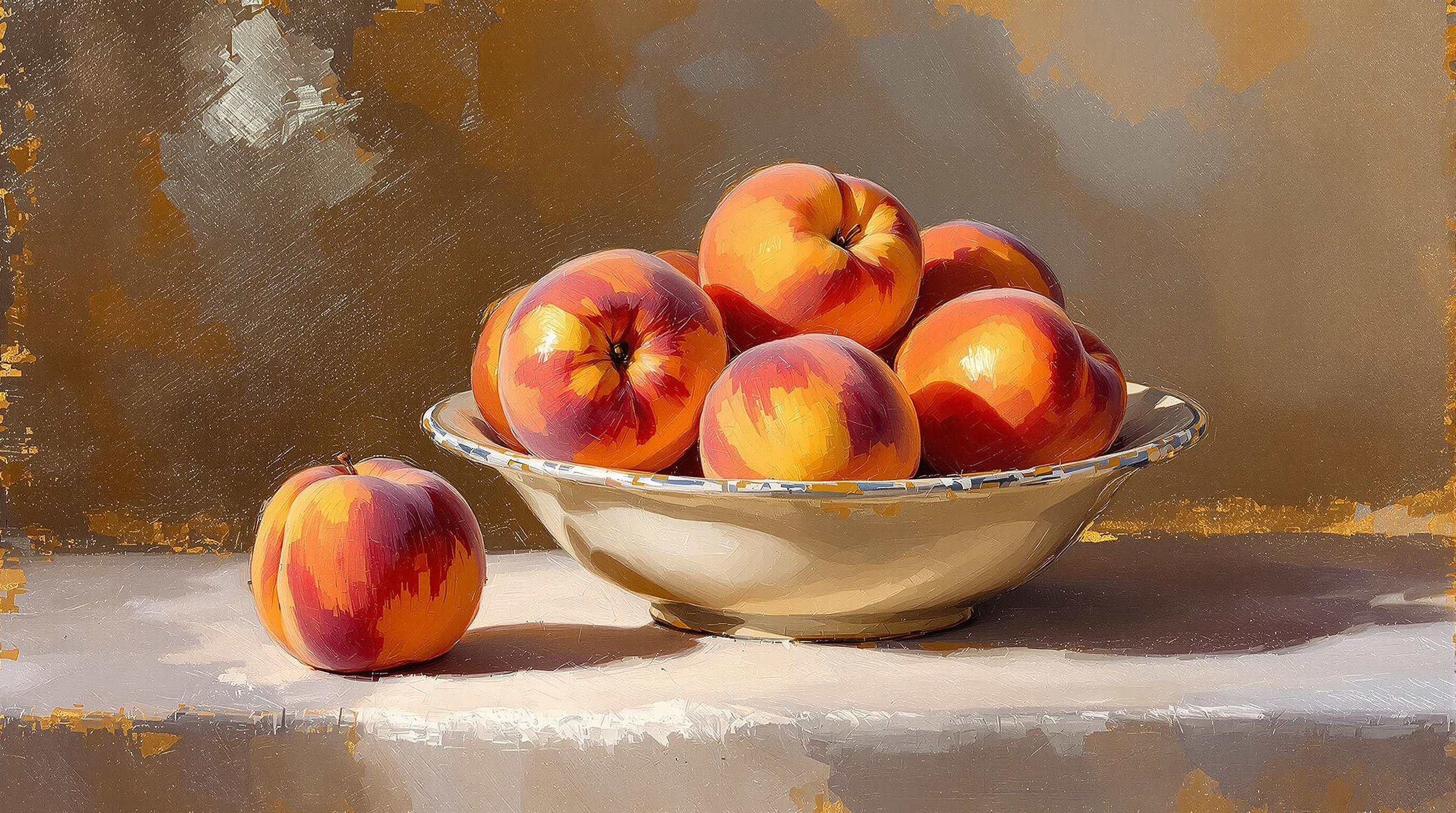
Still life is the genre in which a painter has the fewest excuses. The subject does not move, the light can be held constant for weeks, and the objects can be re-examined at any moment. Everything that goes wrong is therefore attributable to the painter — which is exactly why it has been the standard teaching subject for four centuries, and why it remains the core of most studio curricula in the Southern Highlands.
The English term translates the Dutch stilleven, which came into use in the seventeenth century to describe a category of picture that had by then become a commercial genre in its own right. Dutch and Flemish painters developed several distinct sub-types: the ontbijtje or breakfast piece, sparse and tonal; the pronkstilleven, an ostentatious display of silver, glass and imported fruit; and the vanitas, in which a skull, a guttering candle or a stopped watch converted the arrangement into an argument about mortality.
That last category is worth knowing because it explains a habit the genre never lost. Still life objects tend to be legible as more than themselves — a cut lemon, a tipped glass, a wilting bloom all carry inherited freight. A painter can ignore this, but the viewer generally will not.
The decisions that determine whether a still life works are mostly made before any paint is mixed: which objects, how many, how lit, and from what height.
The strongest arrangements are usually built on a small number of principles. Odd numbers of primary objects avoid the static symmetry of pairs. Overlap creates depth far more efficiently than scale difference. A single dominant light source — traditionally high and from the left, though the direction matters less than the singularity — produces a coherent shadow logic; two competing sources produce a picture that reads as confused even when every individual passage is well painted. And the eye level chosen for the arrangement changes the character entirely: a low viewpoint monumentalises ordinary objects, a high one flattens them into pattern.
Most of the technical difficulty in still life concentrates in four material types, each with its own rule.
Oil is the traditional still life medium and remains dominant, for a straightforward reason: an arrangement can be held for weeks, so the medium's long working time is an asset rather than an inconvenience. The classical method builds from a monochrome underpainting that resolves value structure, then adds local colour, then glazes. Watercolour still life is a different discipline — the white of the paper is the only white available, so the highlights must be planned and reserved before anything else is laid down. Acrylic occupies a middle position and is common in teaching studios because a study can be completed within a single session.
Still life takes on a particular character in a place with a deep craft economy, because the objects available to arrange are themselves made things — thrown pottery, kiln-formed glass, turned wood, woven cloth. A painter working in the Southern Highlands is likely to be painting objects whose maker they know, which tends to produce a more attentive rendering of how a glaze breaks over a rim or how a fused panel transmits rather than reflects light. The relationship runs both ways: painters here often understand transparency better for having watched glass being made.
The Getty and the North Carolina Museum of Art both publish accessible material on the genre's history and technique for readers who want to follow it further.