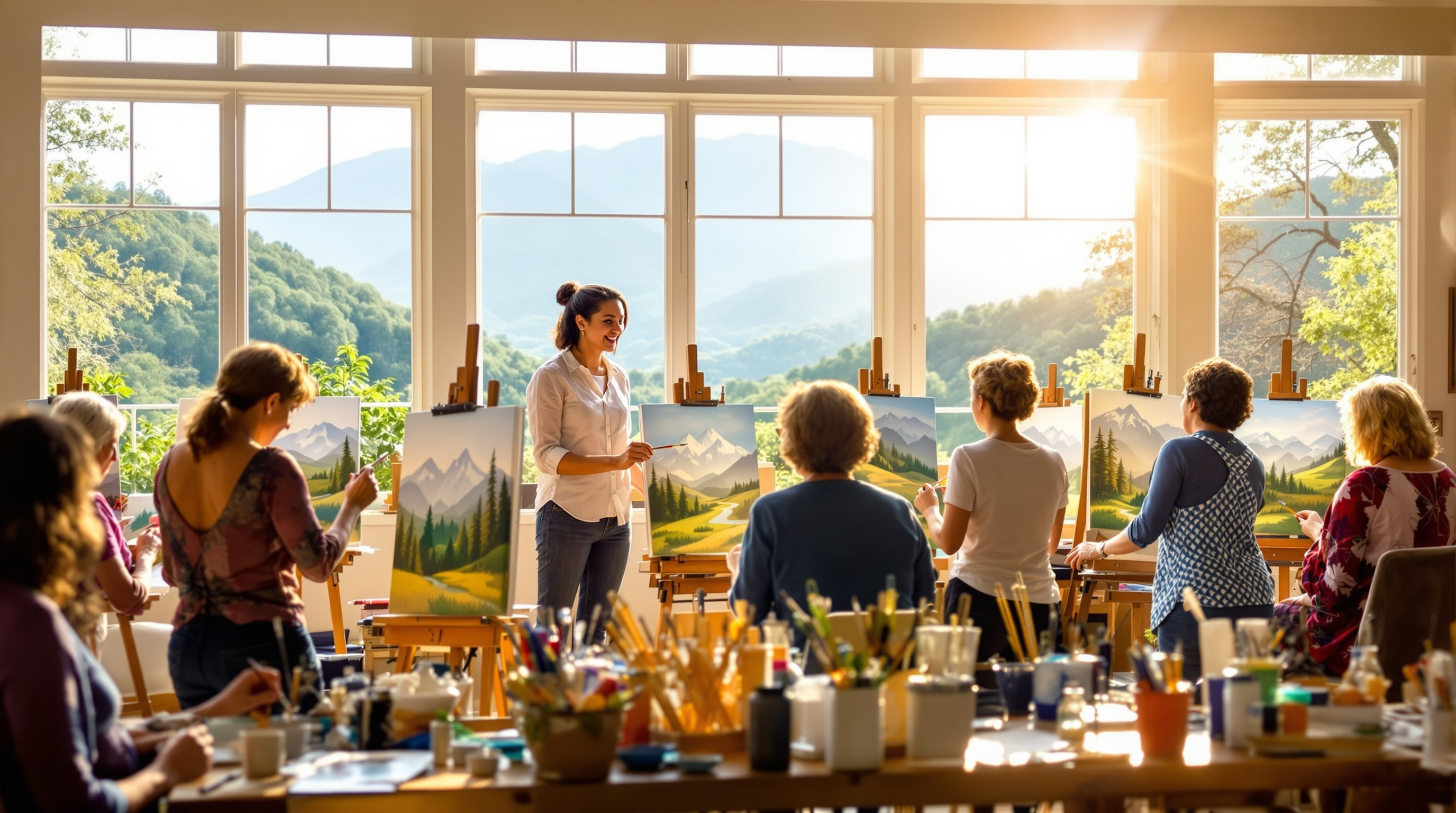
The Southern Appalachians teach an unusual amount of art for a rural region, and the teaching is organised in formats a visitor may not have met elsewhere. This page explains what those formats are, what each is good for, and how to tell a well-run class from a poorly-run one. It is descriptive: Ridge & Kiln does not run classes, does not book them, and does not rank the region's studios.
Teaching in the mountains follows the visitor calendar and the weather, and the two do not always agree. Summer is the peak of scheduled instruction, when residential schools run their full programmes and the seasonal population is present. Autumn is the busiest period for outdoor painting for the obvious reason, and outdoor sessions during peak colour fill fastest of anything in the regional calendar. Winter is quiet, which makes it the best time for indoor disciplines — still life, drawing, glass — and often the time when local groups do their most serious work. Spring is unpredictable enough that outdoor sessions are frequently rescheduled.
The seasonal pattern also has a specific recovery history. In its September 2025 account of the year after Helene, Penland reported reopening for winter residency three months after the storm. That four-week residency hosted 140 artists, and the summer season included more than 100 intensive craft workshops. These are completed milestones, rather than a schedule for a later visit.
The John C. Campbell Folk School's centennial programming provides another way to read a school's calendar: the 100th Anniversary Fall Festival in 2025, a history book released in November 2025, and the Centennial Sounds concert series announced in March 2026 brought institutional history alongside teaching. A workshop, a residency and a commemorative concert serve different purposes; their presence in a school's programme should not be mistaken for interchangeable kinds of study.
The most common beginner mistake is choosing a medium by the look of the finished result rather than by the working method it imposes.
Watercolour is often recommended first and is arguably the hardest. It is unforgiving — corrections are limited, and the white of the paper is the only white there is — so it forces planning of value structure before anything is laid down. That discipline transfers to everything else. Oil is the most forgiving and the slowest: it stays workable for hours or days, which allows genuine reworking, but it needs solvents or solvent-free mediums, ventilation, and somewhere for a wet panel to sit. Acrylic is the practical single-day choice because it dries fast enough to carry home, though that same speed makes blending difficult and pushes beginners toward a hard-edged result. Kiln glass is different in kind: the design work is cold and the outcome is decided by a firing that happens after everyone has gone home, so the feedback loop is measured in days.
A few signals are reliable. A stated class size — and a small one — matters more than any other single factor; twelve is a common ceiling in the region's studios and roughly the point beyond which individual attention stops. A materials list published in advance is a good sign, and so is a clear statement of whether materials are provided. A description that says what will be taught rather than what will be produced usually indicates a teacher thinking about skills rather than souvenirs. And a class advertised as suitable for absolute beginners and experienced painters is either exceptionally well structured or not structured at all.
Ridge & Kiln does not maintain a calendar; regional schedules change constantly and a second-hand listing is worse than none. The North Carolina Arts Council and High Country Arts are the appropriate places to look for current programming, alongside the schools' own catalogues and the Southern Highland Craft Guild for craft media. County arts councils are the route to the local ongoing groups, which are rarely advertised anywhere else.